Upsizing your home is more than just extra square footage—it’s about creating the lifestyle you…
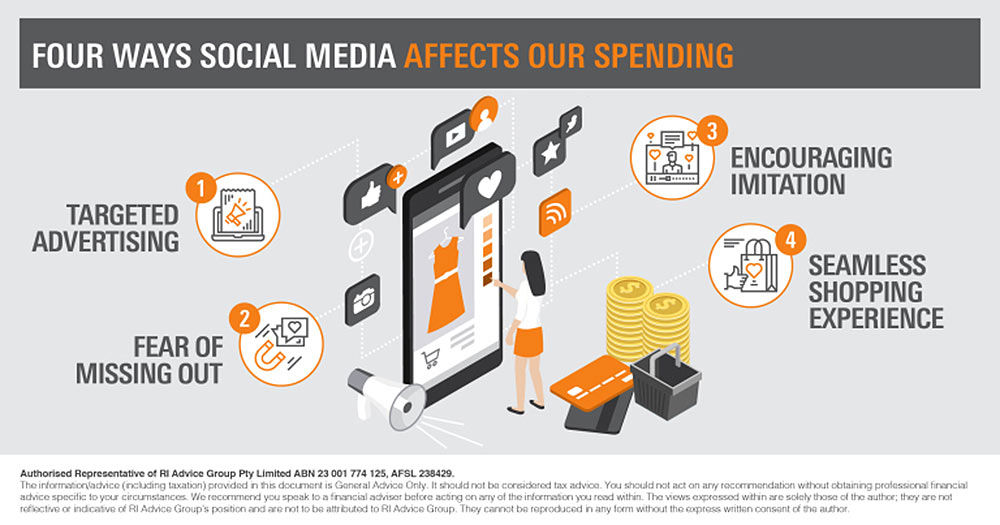
Four ways social media affects our spending
Social media could influence us to spend impulsively.
Can social media use be linked to spending? Research shows it can. For example, one study found that social networks such as Facebook and Instagram can motivate impulsive buying behaviours.[1]
But how does social media affect our spending?
1. Advertising
Sites like Facebook and Instagram have evolved from social networking platforms to powerful advertising tools. We only need to look at our social media feeds to realise how businesses use targeted advertising to expose us to brands, products and services. Targeted posts are effective at getting us to spend because they’re typically developed based on our demographics and even our behaviours.
2. Fear of missing out
Social media creates a tendency among users to compare their lifestyle to those of others. This comparison can trigger a fear of missing out or FOMO, leading us to buy and consume just to fulfil the urge to keep up with everyone else.
3. Encouraging imitation
Images of products or aspirational lifestyles posted on social media by people we respect or admire might influence us to spend unnecessarily or indulgently. This happens when we look to them for cues or guidance when we don’t know how to act and simply copy what they’re doing. Psychologists call this social proofing. [2]
4. Seamless shopping experience
Social media platforms can also encourage spending by providing a seamless shopping experience. For example, Facebook enables retailers to sell on the platform itself, and Instagram lets them add links to products and services mentioned in their posts so users can purchase them online. This makes it extremely easy to spend.
Making smart choices
Social media can help us make better choices by exposing us to more products and services and enabling us to learn about other people’s experiences using them. But it can also influence us to spend unnecessarily or impulsively.
By setting financial goals, you can make smart choices with your money. Your professional financial adviser can help you get started by creating a plan and budget to help you secure your financial future.
To discuss your options, contact Singleton Financial Planning today on 1300 713 733 to book an initial meeting.
NOTES
[1] Aragoncillo, L, 2018, ‘Impulse buying behaviour: an online-offline comparative and the impact of social media’, Spanish Journal of Marketing, accessible at: https://www.emeraldinsight.com/doi/full/10.1108/SJME-03-2018-007.
[2] Psychology Notes HQ, August 2015, ‘What is the Social Proof Theory?’, accessible at: https://www.psychologynoteshq.com/social-proof.
The information/advice (including taxation) on this website is General Advice Only. It has been prepared without taking into account any of your individual objectives, financial situation or needs. Before acting on this advice you should consider the appropriateness of the advice, having regard to your own objectives, financial situation and needs. You should obtain a Product Disclosure Statement relating to the products mentioned, and consider the statements before making any decision about whether to acquire products or services.
We take your privacy seriously and as such we, or RI Advice Group will never ask you to transfer money via email request unless we have spoken to you in person or the transfer is part of an existing arrangement between you and your financial adviser. If you receive any such requests that are outside the agreed arrangements you have with your financial adviser, please contact our office immediately to confirm the validity the request before you take any action – 1800 738 473

Related Posts